AI Tools
Prompt, Skill, Agent, Tool, and MCP: Know the Difference
A practical task walkthrough and comparison table for understanding what Prompt, Skill, Agent, Tool, and MCP each do—and when to use each layer.
Contents
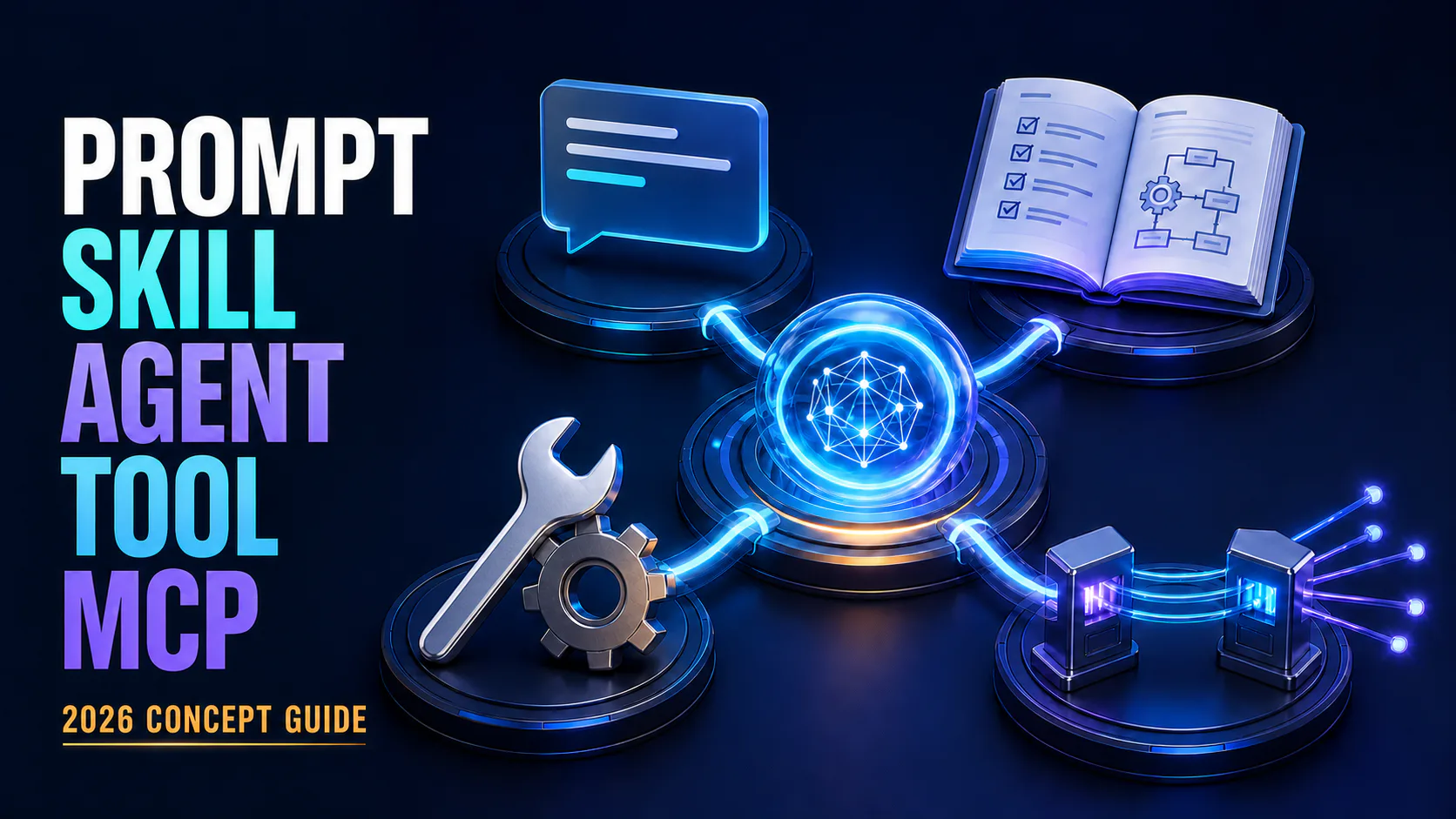
Prompt, Skill, Agent, Tool, and MCP often appear in the same AI discussion, but they are not interchangeable names for the same thing. A long prompt is sometimes called a Skill. Connecting an MCP server is treated as if it automatically creates an Agent. Any chatbot that invokes a function may be marketed as an autonomous system.
Those category mistakes lead to bad design. Teams keep rewriting instructions that should become reusable operating standards, while tasks that need an execution loop are broken into dozens of manual chat turns.
By the end of this guide, you should be able to answer three questions: what each concept owns, how the pieces work together, and which layer a specific task actually needs.
Concepts checked on: 2026-08-28
Note: Vendors do not always use Skill and Agent in exactly the same way. This guide uses a practical, cross-platform engineering definition and calls out important implementation differences.
The short answer: these concepts sit at different layers
Start with five working definitions:
- Prompt: the instructions and context given to a model for the current interaction.
- Skill: a discoverable, reusable, and maintainable operating package for a class of tasks.
- Tool: one executable capability, such as search, file access, a database query, or email delivery.
- MCP: an open protocol for connecting AI applications to external context and capabilities; it can expose Resources and Prompts as well as Tools.
- Agent: a running system that works toward a goal, chooses actions, observes results, and continues until a stopping condition is reached.
A common arrangement looks like this:
You use a Prompt to state the goal. The Agent selects an appropriate Skill, discovers or calls Tools directly or through MCP, reads the results, and continues until the work is complete, blocked, or requires human judgment.
This is a common composition, not a mandatory stack. An Agent can work without a Skill. A Tool can be integrated through a normal API instead of MCP. An MCP server can support an ordinary chat application. The useful distinction is between instruction, method, action, connection, and execution ownership.
Walk through the stack with one quarterly report
Suppose you ask: “Use our company data to produce a Q3 product-operations report. Focus on growth, retention, and adoption of core features, and deliver a document that executives can read directly.”
That request is a Prompt. If the system only writes from text you pasted into the conversation, it may still be a single model call.
An execution-capable Agent goes further. It decides which data is required, which metric definitions apply, what information is missing, and how the result should be checked. It may load a “quarterly operations report” Skill containing the approved metrics, analysis sequence, document template, and QA checklist.
The Agent then uses several Tools: query the data warehouse, read the previous quarter’s report, run calculations, and write the final document. Those Tools may be integrated directly or exposed by an MCP Server.
If the Agent needs relevant passages from a large archive, the system may use RAG to retrieve them. The Agent then checks the draft against the Skill’s acceptance criteria and revises before delivery.
| Layer | Responsibility in the report task |
|---|---|
| Prompt | State the current goal, scope, audience, and output format |
| Skill | Define the standard process, metrics, template, and checks |
| Tool | Query data, read files, calculate metrics, and write the document |
| MCP | Standardize discovery and connection to external context and capabilities |
| Agent | Decide what to do next and adapt to intermediate results |
| RAG | Retrieve relevant evidence from reports and policy documents |
Prompt: what should the model do this time?
A Prompt is an instruction, question, example, or piece of context sent to a model. It may be one sentence or a long task brief with role, data, constraints, and an output schema. Length does not change its category: a 2,000-word instruction can still be just a Prompt.
Two common types are:
- System Prompt: establishes persistent role, priority, boundaries, and baseline behavior, such as “do not expose credentials.”
- User Prompt: describes the current job, such as “compare three products and recommend one for procurement.”
Prompts are ideal for exploratory and one-off work. When the process is not stable yet, a Prompt is the fastest way to test it. The tradeoff is repeatability: requirements must be supplied again, team members phrase them differently, and long instruction blocks can contradict themselves.
A useful test is: will someone need to paste these instructions again for the next task? If yes, the work probably still lives at the Prompt layer.
Skill: how should this class of work be done repeatedly?
A Skill is not simply a saved long Prompt. It is closer to a reusable capability package: the system can discover when it applies, load its detailed procedure when needed, and open scripts, templates, references, or QA criteria on demand.
Under the Agent Skills specification, a Skill is at minimum a directory containing SKILL.md. It may also include scripts/, references/, and assets/. The specification uses progressive disclosure: metadata is available for matching, full instructions are loaded when the Skill is activated, and supporting resources are opened only when required.
A mature Skill usually explains:
- when to activate it and when not to;
- which sources of truth must be read first;
- the required sequence of work;
- which tools or scripts may be used;
- the acceptance criteria for the output;
- how to handle missing data, failures, and high-risk actions.
| Dimension | Prompt | Skill |
|---|---|---|
| Lifecycle | Serves the current interaction | Persists, evolves, and can be versioned |
| Activation | Entered directly by the user | Discovered and loaded when relevant |
| Structure | Instructions and context | Manual plus optional scripts, templates, and references |
| Team use | Easy to fragment into personal versions | Can become a shared operating standard |
| Goal | Produce this result | Make a class of work repeatable |
“Skill” is not used identically by every product. Some platforms apply the label to saved prompts, shortcuts, or specialized tools. In architecture discussions, clarify whether Skill means a reusable operating package or a vendor-specific feature.
Tool: perform one concrete action
A Tool is a capability that a model or Agent can request. It normally has a clear name, input, and result, for example:
search_web(query)searches the web;read_file(path)reads a file;query_sales(start_date, end_date)queries sales records;send_email(to, subject, body)sends an email;run_tests(scope)runs a test suite.
A Tool answers “can the system perform this step?” It does not normally own the plan for the entire job. An email Tool can send a message, but it does not decide who should receive it, whether the language is compliant, or whether sending it achieved the user’s goal.
Tools are not necessarily stateless or harmless. Reading weather data may be read-only; placing an order, deleting a file, or sending a notification changes external state. Production Tools therefore need explicit permissions, risk labels, retry behavior, and confirmation rules.
Function Calling: one mechanism for using Tools
With Function Calling, the model produces a structured request for a Tool. The application validates the arguments, executes the function, and returns the result to the model. OpenAI’s Function Calling guide describes this as a multi-step exchange between the model and application-provided functions.
Function Calling is an important building block, but support for it does not automatically make a system an Agent. An application that always invokes one fixed function and returns the result is better described as a tool-enabled assistant. Agent behavior depends on multi-step goal pursuit, environmental feedback, and route adjustment.
MCP: standardize the connection, not the decision
MCP stands for Model Context Protocol. The MCP 2026-07-28 specification defines an open protocol through which LLM applications connect to external data and capabilities. It describes communication and capability discovery among Hosts, Clients, and Servers.
Calling MCP “USB-C for AI” is a useful introduction, but it needs two qualifications:
- MCP is not limited to Tools. Servers may expose Resources and Prompts, and the current specification defines optional extensions including Skills over MCP.
- MCP does not supply business judgment. It exposes and transports capabilities; it does not automatically decide the goal, action order, or acceptance criteria.
Connecting an MCP server therefore means that the application has a standardized integration path. Whether the overall system is an Agent depends on the model, instructions, orchestration, permissions, state, and feedback loop around that connection.
The reverse is also true: Agents do not require MCP. Direct APIs and local functions can work well. MCP becomes valuable when the same capabilities should be discoverable across compatible clients or governed through a consistent integration surface.
Agent: keep working toward the goal
An Agent is not a separate species of model. It is a running system that combines a model with instructions, context, state, Tools, and an execution loop.
A practical Agent loop usually does five things:
- understand the goal and constraints;
- choose the next action;
- select a Skill or Tool;
- execute and observe the real result;
- continue, revise, request human judgment, or stop.
There is no single industry-wide definition of Agent. A useful engineering boundary comes from Anthropic’s Building Effective Agents: Workflows route models and Tools through predefined code paths, while Agents allow the model to dynamically direct its own process and Tool use.
Three questions help determine how agentic a system really is:
- Does the model choose intermediate steps from live information, or are all routes hard-coded?
- Does the system inspect Tool results and errors before deciding what happens next?
- Does it have explicit stopping conditions for success, failure, and required authorization?
A question-answering chatbot normally fails these tests. A single-function assistant may satisfy part of them. A coding system that reads a failing test, changes the code, reruns the test, and adjusts again is much closer to an Agent.
Where RAG, Workflow, Memory, and Multi-Agent fit
These terms often appear beside the core five, but they answer different design questions.
RAG: retrieve evidence for the response
RAG, or Retrieval-Augmented Generation, retrieves relevant material from a document store or search system before generation. It answers “which information should ground the output?” It does not define the complete operating procedure.
A knowledge base is a reference library; a Skill is a work instruction. A Skill may say “retrieve the latest policy before analysis,” while RAG finds the relevant policy passages.
Workflow: run known steps predictably
A Workflow is a predefined sequence suited to stable steps, known branches, and auditability. “Receive invoice → extract fields → validate tax ID → write to the finance system → notify accounting” is usually a Workflow-shaped problem.
Agents are better when the goal is clear but the path cannot be fully enumerated. Mature systems often combine both: an Agent decides which situation applies, and a Workflow executes the known section reliably.
Memory: retain state across steps or sessions
Memory answers “what should the system remember?” It may store task state, user preferences, prior decisions, or durable facts. Memory does not automatically become a Skill. “This user prefers concise reports” is state; “this is the approved report process and checklist” is an operating standard.
Multi-Agent: organize multiple execution roles
Multi-Agent systems divide work among several Agents—for example, research, drafting, and review coordinated by an orchestrator. They are useful when work can be partitioned clearly and the parallelism or specialization outweighs coordination cost.
Sending the same vague task to more Agents does not automatically improve quality.
Comparison table: purpose, form, and common misuse
| Concept | Working definition | Main question | Common form | Common misuse |
|---|---|---|---|---|
| LLM | Model for understanding, reasoning, and generation | How is language and information processed? | Model or API | Treating the model as the whole application |
| Prompt | Instructions and context for this interaction | What is needed now? | Text or multimodal input | Repeating the whole company SOP in every chat |
| Skill | Reusable operating procedure and resources | How should this work be done consistently? | SKILL.md, scripts, templates, references | Calling every saved prompt a Skill |
| Tool | One executable capability | Can the system perform this step? | Function, API, command, app action | Hiding an entire business process in one vague Tool |
| MCP | Open protocol for external context and capabilities | How should integrations connect? | Host, Client, Server, protocol messages | Assuming MCP automatically creates an Agent |
| Agent | System that dynamically pursues a goal | Who moves the whole task forward? | Model + instructions + Tools + state + loop | Calling every tool-using chatbot an Agent |
| RAG | Retrieval before generation | Where does the evidence come from? | Retrieval system + model | Replacing operating standards with a document store |
| Workflow | Predefined execution path | How do known steps run predictably? | State machine, orchestration graph, script | Forcing open-ended judgment into a fixed path |
Choose the right layer for the task
One-off work with easy human review
Start with a Prompt. Rewriting one email, explaining a code sample, or preparing a single meeting agenda rarely needs a larger system while the process is still being discovered.
Repeated work that needs consistent steps and quality
Create a Skill from the stable parts. Weekly performance analysis, blog publishing, contract review, and incident retrospectives benefit from explicit triggers, source-of-truth rules, procedures, boundaries, and checks.
Work that must read live data or change external state
Provide Tools. Inventory checks, file reads, test runs, ticket creation, and notifications require executable capabilities. Apply least privilege and confirmation to write, delete, payment, and external-communication Tools.
The same capabilities must serve several AI applications
Consider MCP. It can expose Tools, Resources, and Prompt templates through a common interface. For one small internal application, a direct function or API integration may still be simpler.
The goal is clear but the route depends on intermediate results
Use an Agent. “Find and fix the cause of these failing tests” cannot predict in advance how many files or iterations will be required. Give the Agent permission boundaries, budgets, timeouts, and stopping criteria.
The path is fixed, auditable, and rule-driven
Prefer a Workflow. Do not make the model re-decide a process that is already known. Use an Agent only at nodes that genuinely require semantic judgment.
Five common category errors
A long Prompt becomes a Skill
It does not. Length is not the boundary. A Skill needs an explicit scope, discovery mechanism, maintainable structure, reusable resources, and repeatable quality standards.
Connecting MCP creates an Agent
It does not. MCP solves integration; an Agent solves decision-making and task closure. A chatbot connected to an MCP server may still be only a chatbot with access to more context.
Any Tool call proves the system is an Agent
Not necessarily. A fixed call followed by a direct response lacks ongoing observation, adjustment, and stopping logic. It is an Agent building block, not automatically a complete Agent loop.
RAG can replace a Skill
It cannot. RAG retrieves what the reimbursement policy says. A Skill specifies which clauses to check, how to handle exceptions, and how to document the review.
Agent is always more advanced than Workflow
It is not. Fixed, high-risk, audit-heavy processes often need Workflow predictability. Open-ended work with uncertain paths benefits from Agent judgment. Complexity should serve the outcome rather than the product label.
Upgrade from a Prompt to a working system
A reliable path is incremental:
- Make the task work with a Prompt. Confirm that the task has value and observe how people actually complete it.
- Identify repeated instructions. Capture recurring steps, constraints, formats, and checks.
- Create a Skill. Organize the stable procedure, references, templates, and scripts into a maintainable package.
- Add Tools. Turn real-data access and external operations into clear, narrow capabilities.
- Adopt MCP when it helps. Standardize the connection when capabilities need cross-client reuse or common governance.
- Give dynamic choices to an Agent. Delegate only the route decisions that genuinely depend on environmental feedback.
- Improve through evaluations and logs. Track completion rate, human takeover points, Tool failures, cost, and risk—not only whether the answer sounds fluent.
At that point, AI has moved from one-off content generation to a repeatable delivery system.
A final mental model
If you want the shortest version, use a restaurant:
- Prompt is the current table’s order and dietary restrictions.
- Skill is the reusable recipe and plating standard.
- Tool is a knife, stove, register, or ordering system.
- MCP is the common integration standard for kitchen equipment and systems.
- Agent is the chef who understands the order, selects the recipe, uses the equipment, checks the dish, and decides whether it needs another pass.
- RAG is the process of looking up seasonal ingredients and supplier information.
- Workflow is the fixed production line already established in the kitchen.
The practical question is not which acronym sounds most advanced. Ask what is missing: a current instruction, a reusable method, an executable capability, an integration standard, grounded knowledge, or an execution owner that can carry the goal to completion.